Showing posts with label paleontology. Show all posts

Friday, September 30, 2011

The Great Cretaceous Walk Takes a Rest


About six weeks ago, I shared the happy news of our discovering dinosaur tracks at Milanesia Beach, Victoria, which turned out to be the largest collection of polar dinosaur tracks known in the Southern Hemisphere. Those tracks were found during the month-long excursion (May-June 2010) along the Victoria coast that inspired the start of this blog. And although we found heaps more trace fossils, the tracks constituted out most important scientific find. So even though we have a but more science to do, this is as good of a time as any with this blog to say, “Catch you later” and make a transition both geographical and temporal.
The Great Cretaceous Walk has been very, very good to me. But it’s time to take a pause in all of the walking and talking about the Cretaceous of Australia, and look closer to home (Georgia) and at this time in the present (otherwise known as “now”). Photo by Tom Rich, and taken on May 28, 2011 (Day 2) of our month-long field survey of the Cretaceous trace fossils of Victoria.

Monday, March 7, 2011

Fossil Collectors and Academic Paleontologists: Grudge Match, Love Fest, or a Little of Both?


In July of 2010, while in the small outback-Queensland (Australia) town of Boulia – mentioned in a previous entry – I was reminded through one simple question about a huge cultural and communicative gap dividing many people otherwise connected through their mutual love of fossils. The question, posed to me by Dick Suter, an extraordinary fossil collector who lives in Boulia, was: “Do you have a Ph.D.?” I have heard this question before in both the U.S. and Australia, and it is almost never asked out of curiosity, but to pick a fight. This time was no different, as I sensed his inquiry was tinged with antagonism. I braced myself, and said, “Yes.”

Here I am, having a cordial conversation with fossil collector Dick Suter (right) of Boulia (Queensland, Australia) at the Stone House Museum. He was a great guy and had lots of paleontological experiences to share during our visit with him, for which we were grateful. Just don’t tell him you’re a paleontologist and have a Ph.D. Photo by Ruth Schowalter.

Thursday, February 24, 2011

Dreaming of Dinosaur Dreaming


Humans like to celebrate anniversaries during their lifetimes in fives and tens, which I like to think is a direct reflection of a much longer evolutionary heritage. For instance, why fives and tens, and not, say, threes or sevens? Look at your hands and feet, count your fingers and toes, and see what totals you get for each appendage (yakuza excluded). These numbers are a result of our having descended from synapsids (“mammal-like reptiles”) that likewise had five digits on each end of four limbs. In fact, all mammals are synapsids, and the last common ancestor synapsids shared with dinosaurs and other egg-laying reptiles was more than 300 million years ago. Humans and most other mammals don’t lay eggs (albeit, some placental mammals like to hatch from eggs), but a few still do – monotremes, such as platypuses and echindnas – thus demonstrating a lingering trait of this reptilian ancestry.

So it was this week that I was reminded of a five-year anniversary, the evolutionary history of mammals, and our long-lost connection to dinosaurs, thoughts that all coincided as they were triggered by remembering the Dinosaur Dreaming dig site in Victoria, Australia.

No, these people are not incarcerated and carrying out their sentences by cracking rocks all day in the summer sun. They actually are: volunteers at the annual Dinosaur Dreaming dig site in coastal Victoria, Australia; looking for fossils of Cretaceous dinosaurs, mammals, turtles, and other animals; and very much enjoy doing this. Really.

Wednesday, February 16, 2011

Of Min Min Lights and Ichthyosaurs


As loyal readers know from previous entries, following field work in Victoria, my wife Ruth and I went on a paleontologically themed “drive-about” (as opposed to walkabout) in western Queensland last July 2010. We started in Townsville, and went west from there (after all, going east would have put us in the Coral Sea). We then paused for a fun day and night in Hughenden, followed by three glorious days and nights in Winton. Where to go next for a married couple in pursuit of more knowledge about fossils and their role in inspiring the human imagination in Australia? Well, how about Boulia?


An artistic recreation of Cretaceous ichthyosaurs frolicking like dolphins at the Stone House Museum in Boulia, Queensland (Australia), thus providing a good example of how convergent evolution influences art: mural by Rona Thoragood (1997). For more about intersections between paleontology and art in outback Queensland, check out Ruth Schowalter’s (Hallelujah Truth’s) musings here and here.

Sunday, January 9, 2011

Who Made the Three-Toed Dinosaur Track?


In paleontology, occasionally a scientific hypothesis rules for several decades or more and enters the public realm, becoming part of popular lore. Nonetheless, science is always changing, which means that what we took for granted as a “true” story can be upended in a way that surprises everyone, perhaps even the paleontologists doing the revising. Such is the situation with the “giant-stalking-theropod-dinosaur-causing-a-dinosaur-stampede” story of the Lark Quarry dinosaur tracksite in Queensland (Australia). This tale has been reigning for more than 30 years and is known worldwide by paleontologists and laypeople alike, but now faces a makeover in the light of new evidence.

Here are some dinosaur tracks from Queensland, Australia. The dinosaurs that made them had three toes on their rear feet, and walked only on those two feet (bipedally). So were these from theropod dinosaurs or ornithopod dinosaurs? Don’t know? Then I guess you’ll have to read more, won’t you? Display is at the Museum of Tropical Queensland in Townsville, Queensland (Australia). Note the stylish sunglasses (lower right) for scale.

Sunday, December 12, 2010

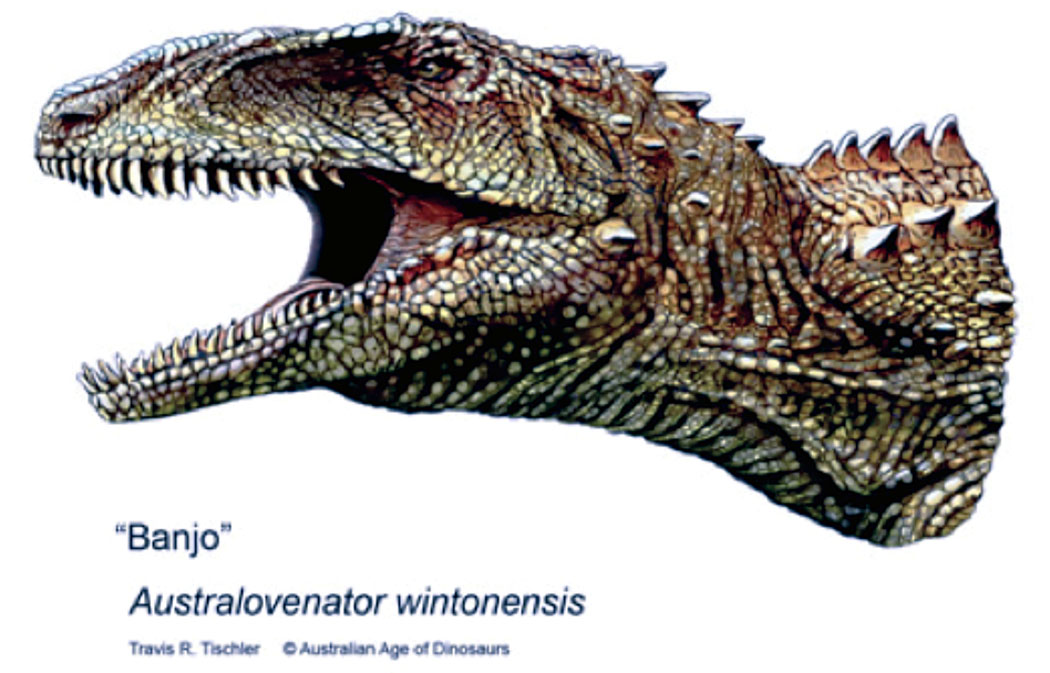
Clancy, Matilda, and Banjo: Australian Dinosaurs, Living Large


“Discoveries are the currency of science.” When I heard renowned biologist and Pulitzer-Prize winning science author E.O. Wilson say these words several years ago during a visit to Emory University, I have reminded myself since of how the continuing discoveries of dinosaurs and other fossils probably reflect the most cost-effective way for science to progress. And when it comes to paleontology, few places in the world have yielded better “bang for the buck” than Australia.
“G’Day! My name is Banjo. I have come here to chew bubblegum, and kick bum. And I'll all out of bubblegum.” Fantastic artwork by Travis Tischler, Australian Age of Dinosaurs.

Saturday, November 13, 2010

Cretaceous Worlds of Queensland, Part III: Hughenden, on the Edge of the Cretaceous


If you want to visit the former locations of the Cretaceous seaway that cut through Australia 100 million years ago, as well as its coastal and landward environs, the easiest way to do this is to fly into Townsville, Queensland (mentioned in last week’s entry), rent a car, and drive west.


This is the point in the narrative where someone might invoke the cliché, “Go west, young man,” but I do not qualify as “young” any more, plus my wife - Ruth – was with me on this journey. Thus inclusivity, as oppposed to ageism and sexism, negate my saying that phrase. Regardless, I try to avoid clichés like the plague, but your mileage may vary, depending on how you roll the dice. (After all, no matter where you go, there you are.)


A paleogeographic map of northeastern Queensland 100 million years ago, during the Cretaceous Period; map from the Museum of Tropical Queensland. Arrow points to Hughenden, the subject of this post. Notice how that area was coastal then (the white part represents the inland sea). Also note the inconvenient lack of roads during the Cretaceous.


Renting a car in Townsville for going into the Australian outback can be a bit tricky, as rental agencies frown on their vehicles going onto unsealed surfaces, including dirt roads. In sympathy with rental agency employees, who probably have a litany of horror stories about crazy foreigners destroying life, limb, and (most importantly from their perspective), property, I certainly understand the “off-road” restriction for a car that does not have four-wheel-drive, roll bars, exhaust pipe running above the roof, Kevlar tires, and other battle-ready accoutrements that many Australians advocate for driving in their continental interior. But to me, it seems too cautious to keep perfectly fine all-wheel-drive (AWD) cars off dirt roads that are marked clearly on a standard road map and government maintained.


So for the sake of privacy and not wanting to offend the agency that so kindly rented us a vehicle, please consider any mentions of driving on dirt roads as pure fiction.


The sport “ute” (utility vehicle) used for field work in Victoria, Australia during The Great Cretaceous Walk in May-June 2010, courtesy of the Museum of Victoria. This is the type of field vehicle you need to take for dealing with the harsh Australian outback, although a good number of Australians in recent years have been using them for just driving to Woolie’s to stock up on vegemite and VB. Alas, we lacked such a vehicle in Queensland, yet we somehow survived.


We did take one serious precaution that many of our Australian friends suggested, which was to keep lots of water in the car. This safeguard is in case you get a flat tire or otherwise break down several hundred kilometers from the next town, as help might be a long time in coming and you should have plenty of drinking water on hand. Fortunately, Townsville has many grocery stores that stock 20-liter jugs of water, so we purchased two of these and kept them in the “boot” (or “trunk,” for all you Yanks out there). Incidentally, these jugs rode several thousand kilometers with us and ultimately returned unused to Townsville, which we donated to our hotel before departing. Oh well: better safe than thirsty.


Properly stocked with our sloshing supply of dihydrogen monoxide (the deadliest substance known to humankind), we left on the morning of June 30, and drove southwest for about three hours – passing through only a few pub-hotel “towns” along the way – before arriving at the first paleontologically significant town, Hughenden. I had visited Hughenden about three years previously (2007) during a whirlwind weekend trip from Townsville to the outback (and back), and was looking forward to seeing it again. Of course, I was also curious how it might have changed during the intervening time.


What to see in Hughenden, and why stop there, especially if someone is eager to make it to Winton? Well, how could a dino-phile avoid pausing for a visit after being greeted by a life-sized replica of the ornithopod dinosaur Muttaburrasaurus langdoni? This prodigious example of paleo-statuary is hard to miss, and is easily spotted on the right side of the road as you drive into town, located next to an old-fashioned outback pub hotel (sadly closed).


The large and very friendly Cretaceous ornithopod dinosaur Muttaburrasaurus, a roadside icon for Hughenden. Look at the size of this beauty! Photo by Ruth Schowalter.


Hughenden also has a very nicely arranged display of local fossils and some information about the local natural and human history, housed in the Flinders Discovery Centre. For only $3.50 (AUD) admission, you can see a short film about the geologic history of the area (which actually was quite good), walk and gawk through the display to your heart’s content, take as many photos as your digital-memory card can hold, and otherwise enjoy learning about the rich natural history of central Queensland. The star of the display, though, is a mounted cast of a Muttaburrasaurus skeleton.


If you didn’t like the Disney version of Muttaburrasaurus pictured earlier, here’s the Tim Burton one, which can be viewed in all of its awesomeness in the Flinders Discovery Centre.


This dinosaur, besides having what is probably the most fun-to-say dinosaur name (other than Micropachycephalosaurus), is the largest known ornithopod in Australia, which was apparently overrun with smaller, “hypsilophodontid” dinosaurs, especially in Victoria. Also unlike the Cretaceous dinosaurs of Victoria, this dinosaur is known from a nearly complete skeleton, including a skull. It derived its colorful name from a small town south of Hughenden near where it was found – Muttaburra – which in turn is named after an indigenous word, meaning “meeting of the waters.” This is a very insightful appellation, reflecting how this now-dry (almost desert) area did indeed meet a Cretaceous seaway 100 million years ago.


Other fossils are in the Flinders Discovery Centre, most of them Cretaceous, and most of them local, thus showcasing the paleontological importance of this area for understanding Cretaceous life in Australia. In fact, bones from some of the Cretaceous marine reptiles, giant clams (Inoceramus), and ammonites were recognized in this area during the mid 19th century. Many such fossils – most of them real – were out in the open, allowing for unfettered photography, and those below glass in cabinets also beckoned for a close look. (And just as a curmudgeonly aside, I love these smaller, local museums for putting real fossils on display, eschewing the “bells-and-whistles” virtual-reality displays embraced by so many other museums in recent years.)


Wow, look, real Cretaceous fossils! In this case, ammonites of all shapes and sizes, with a modern Nautilus thrown in for contrast and scale.


This beautiful fossil decapod, simply labeled as “Crayfish,” is most likely a marine species, and not a freshwater crayfish (“yabby) for which Australia is famous. Its label also says it is from the Cretaceous, so it would be nice some day to know its exact taxonomic affinity. After all, I have a keen fondness for Australian freshwater crayfish from the Cretaceous.


And you just knew this ichnologist was not going to neglect mentioning trace fossils, and the center had a few displays about those, too.


Cast of a large Australian theropod dinosaur track, which was labeled as “Allosaurus footprint,” but is probably not from that genus, which is North American. (Close enough, as it certainly was made by a large, Allosaurus-sized theropod, though – so no harm done.)


Branching invertebrate burrows preserved in a limestone as natural casts. These burrows are what most ichnologists would call Thalassinoides, trace fossils that are normally associated with crustacean tracemakers.


Ruth was delighted with the artistic portrayals of dinosaurs in the center, some of which would no doubt evoke snickers, chuckles, chortles, and outright guffaws from some of my paleontologically oriented friends because of their postural and chromatic inaccuracy (the dinosaurs, that is, not my paleo-friends). Nonetheless, we enjoyed seeing these included in the display area too, and appreciate all of the local effort that went into constructing these homages to all things dinosaurian.


Kitschy dinosaur-inspired sculptures in the Flinders Discovery Centre, which I think are of an ornithopod (left) and sauropod (right). And if you don’t like them, make your own bloody dinosaurs!


And if that isn’t enough to satisfy any artistic yearnings, metal sculptures of a dinosaur and pterosaurs adorn public spaces outside the center, lending some whimsy along with the well-deserved local pride.


It’s not Truckasaurus, but it’s pretty close. Nicknamed “Darby the Dinosaur,” this sculpture was inspired by Muttaburrasaurus, then conceived and made in 1998 by local artists Terry Lindsay and Sam Brown. They put together whatever spare parts they could find, set their creation in concrete, and garnished it with real Cretaceous fossils (below "Darby").


This would be the last thing you would see if a pterosaur became a Transformer. (Yes, I know, big “if.”) The sculpture is nicknamed “Leanneosaur," and coincidentally, one of the artists (Shane Rogers) who created this metallic menace has a wife named Leanne. The other artist was Terry Lindsay, also partially responsible for “Darby,” and the piece was completed in 2004.


So Hughendgen is a great place to visit for paleo- and art-nerds alike (Ruth and I qualify as both). In fact, we liked Hughenden and the Discovery Centre so much, we made a point of stopping there on our way back to Townsville nearly a week later. That is when Ruth and I purchased a dinosaur hand puppet (a theropod, of course), which was put to good use in a dinner-theater performance only a few days later. (Digression? No, foreshadowing.)


So Ruth and I spent one night in Hughenden, then were off in the morning to our next stop on the “Dinosaur Trail,” which was Winton, a town that lives off past lives of the Cretaceous, as well as the much more recent past. Why? Tune in next week, when I’ll talk about Winton and its connections to paleontology, the unofficial national anthem of Australia, bush poetry, and beer (and perhaps not in that order).


Monday, May 24, 2010

From the Southeast (of the U.S.) to the Southeast (of Australia)

Traveling to Melbourne, Australia from Atlanta, Georgia is both easy and not easy. I say this now after having just completed my seventh trip here, so the voice of experience may sound a bit weary, yet is still filled with excitement about having made my way here again.

Atlanta is a major hub for commercial air traffic, and in fact Hartsfield-Jackson International Airport is the busiest in the world when measured by number of passengers that pass through it. (The old joke in Atlanta is that after you die, before you go to heaven or hell, you change planes in Atlanta.) So it was easy enough to take a direct flight to the Los Angeles International Airport (LAX) from Atlanta and arrive there in five hours. The “not easy” part of every trip to Australia starts as soon as I step off the plane and enter LAX.

I strongly dislike this airport. It is a very unfriendly place, with few personnel available to direct or otherwise assist people, no signs guiding people to the international terminal, and no people movers (such as light rail) to ease the transition from domestic to international travel. No one seems happy here, and few smiles are seen, nor are many laughs heard and exchanged.

This time was no exception, and the tardy domestic baggage-claim, an uncertainty of where to check in for the connecting flight to Australia, and the Rube-Goldberg maze called “security” at LAX, all led to an unnecessarily anxious and stressful time between flights. What seemed like a last-minute check-in at the Qantas gate did not result in my boarding an aircraft, either. Instead, similarly nervous passengers and I were directed to a bus that stood motionless on the tarmac well past the time the plane was supposed to leave. The silence on the bus spoke of everyone’s wondering if we had already missed our flight, and weighing our options if we had.

Once the bus was full, a driver appeared and took us for a long ride through lonely expanses of airport concrete, a stark emptiness punctuated by runway lights, hangars, large passenger planes, and occasional vehicles. After nearly 15 minutes of riding, we arrived at an isolated building next to our plane, the latter recognizable through the Qantas logo, a crimson-kangaroo silhouette. After walking up several flights of stairs in the building, we finally boarded our plane, and sat in our seats for another 45 minutes or so before the long taxi and take-off, more than an hour past our scheduled departure. It was 12:40 a.m. Los Angeles time, and 3:40 a.m. back in Atlanta.

About 15 hours later, we landed in Brisbane, Australia. Attentive readers will note that Brisbane is not the same place as Melbourne, and is actually halfway up the east coast of Australia. Melbourne is located in the southeastern part of Australia, just north of Tasmania.


You are here and not here: locality map for Brisbane and Melbourne in Australia.


Strong winds from the west had impeded our flight enough that it needed to refuel before continuing to Melbourne, and Brisbane was chosen as the place to do that. We stayed on the plane while it refueled for nearly an hour, and took off again for an additional two-hour flight to Melbourne. All told, about 18 hours were spent on the same plane.

Once in Melbourne, though, it became easy again. Immigration, baggage claim, and customs took all of 20 minutes. In the Melbourne International Airport, you feel welcomed to Australia. A bus ticket took minutes to purchase; another minute was needed to walk outside to the bus that drove directly to downtown Melbourne; another minute to catch a quick taxi ride to the Melbourne Museum.


Exhibition Hall of the Museum of Victoria.

So less than an hour after landing on that cloudy Monday morning, I was shaking Tom Rich’s hand and chatting amiably with him and other friends at the museum about all things paleontological. Later that same afternoon, I looked in museum collections at fossil insects from the Koonwarra Formation, an Early Cretaceous sedimentary deposit east of Melbourne. LAX was now an errant bad dream, fading into insignificance as I stared at the remains of mayfly nymphs preserved on a lake bottom from more than 115 million years ago. Perspective helps.

This is the surreal part of such travel, informed and motivated by paleontology. After all that transpires, you are back in a familiar world, one where hours and minutes are meaningless, and the fossils and rocks give you reason to understand that it was all worth the hassle. Because ultimately it is much easier for you to go to the rocks and fossils than for the rocks and fossils to come to you, and your time spent to greet them diminishes when viewed in the light of what brought you there.

That evening, walking with Tom through Carlton Gardens outside of the museum, I spotted a mother brushtail possum ambling along, carrying an ample-sized youngster on her back. They were startled when I stopped to look at them, and the young possum reacted by jumping off momma-possum’s back. They each ran a short ways before turning to stare back at me, this odd person who is curious about them. Like squirrels in the U.S., they are more used to people ignoring them, urban wildlife that becomes as much a part of the local background as a traffic light. I smile and delight in having this brief connection with these commonplace animals that so much define this place, despite the bemused reactions of Australians to my interest.

That was yesterday here, Monday, May 24. Today holds more museum time, more settling into this place and time, and preparations for field work starting on Thursday, the unofficial start of The Great Cretaceous Walk. Look for an entry that continues a story of a previous time here, titled Luck, Preparation, and Opportunity: Part II.