Friday, September 30, 2011

The Great Cretaceous Walk Takes a Rest


About six weeks ago, I shared the happy news of our discovering dinosaur tracks at Milanesia Beach, Victoria, which turned out to be the largest collection of polar dinosaur tracks known in the Southern Hemisphere. Those tracks were found during the month-long excursion (May-June 2010) along the Victoria coast that inspired the start of this blog. And although we found heaps more trace fossils, the tracks constituted out most important scientific find. So even though we have a but more science to do, this is as good of a time as any with this blog to say, “Catch you later” and make a transition both geographical and temporal.
The Great Cretaceous Walk has been very, very good to me. But it’s time to take a pause in all of the walking and talking about the Cretaceous of Australia, and look closer to home (Georgia) and at this time in the present (otherwise known as “now”). Photo by Tom Rich, and taken on May 28, 2011 (Day 2) of our month-long field survey of the Cretaceous trace fossils of Victoria.

Sunday, August 14, 2011

Discovering the Dinosaur Tracks of Milanesia Beach


(In my previous entry, I described the start of a day in the field – June 14, 2010 – at Milanesia Beach, Victoria (Australia), just hours before Tom Rich, Greg Denney and I discovered the largest assemblage of polar dinosaur tracks in the Southern Hemisphere. In that entry, I also pointed out how few dinosaur tracks had been documented in Victoria before then, which also meant very few polar dinosaur tracks had been found in the Southern Hemisphere. This background gave some context on why this find is a big deal, paleontologically speaking. So, would you like to want to learn how these tracks were discovered? Then read on.)

As Tom Rich, Greg Denney, and I walked down Milanesia Beach the morning of June 14 2010, my thoughts were about the dearth of dinosaur tracks found thus far in Victoria, Australia. Geological research of these Cretaceous-age rocks had been going on for more than 100 years, and paleontological studies there had been particularly intense during the past 30 years. Yet during that time, only four definite dinosaur tracks had been discovered in all of the extensive Cretaceous outcrops of coastal Victoria. Moreover, all of these were individual prints, with no dinosaur trackways showing at least two sequential steps. The previous three weeks of field work Tom and I had done along the coast seemed to bear out this notion that dinosaur tracks were rare here, even scarcer than their bones.

Nonetheless, I also tried to shake a premonition, experienced only a half hour after arriving at Milanesia Beach, that we might find dinosaur tracks there. Rest assured, this hunch was not inspired by séances, Ouija boards, psychic-pet hotlines, or any other forms of necromancy. Instead, it was based on our seeing the physical sedimentary structures and small invertebrate trace fossils (burrows) that told me we were looking at the former deposits of river floodplains. These environments would have been perfect for preserving dinosaur tracks. Regardless, I reminded myself to just be a cold, clear-headed, objective scientist: you know, a pessimist.

 A few more of the dinosaur tracks of Milanesia Beach, Victoria (Australia). Three size categories were there: small, medium and large, all made by three-toed theropod dinosaurs. Greg Denney found the ones shown here, which he discovered by recognizing how this rock matched another one with dinosaur tracks that I had found just a few hours before. Please buy him an adult beverage next time you see him, slap him on the back, and say, “Good on ya, mate!”

Tuesday, August 9, 2011

The Dinosaur Tracks of Milanesia Beach: Part I


Because of the sparse and uneven record of dinosaurs in Australia, their fossil footprints are more valuable here than anywhere else on Earth.

- Thomas H. Rich and Patricia Vickers-Rich, A Century of Australian Dinosaurs (2003).

The Preamble

Dinosaur tracks are hard to find. This humbling realization struck me during the third week of a month-long field excursion in May-June 2010, while doing field work along the craggy coast of Victoria, Australia. Why was I there, engaging in such an apparently fruitless quest? Paleontologist Tom Rich of Museum Victoria had invited me to look for trace fossils made by dinosaurs and other Cretaceous animals that might be preserved in the rocks of Victoria. Yet as was often the case with looking for fossils of any kind, there were no guarantees of success. He and I had already searched more than a hundred kilometers of coastal cliffs and platforms east of Melbourne, and were then working our way through sites west of there.

Here are four three-toed dinosaur track,s preserved on a block of sandstone at Milanesia Beach, Victoria (Australia). They’re faint, but there – look closely for all four. These tracks were probably made by small theropods on a river floodplain during a polar summer about 105 million years ago, when Australia was close to the South Pole. On June 14, 2010, I discovered the block that contained these tracks, and a few hours later, Greg Denney found another block with more tracks. This is a big deal, as they represent the greatest number of polar dinosaur tracks found in any one place in the Southern Hemisphere. It’s enough to make you want to do a happy dance. Scale bar in photo (lower left) = 10 cm (4 in).

Monday, July 18, 2011

Cruising the Cretaceous of Queensland: Student Edition


Earlier this month – July 4-8, 2011 – was my third time to see the wondrous Cretaceous fossils of Queensland, Australia. But it was my first with university students in tow to share in that paleontologically inspired excitement. Our trip together to outback Queensland was during the third week of a five-week program for Emory University students taking a study-abroad program in Australia, taught by me and my good friend (and oh yeah, colleague) Steve Henderson from Oxford College of Emory. We did this trip to give them a taste of what life was like in the modern-day outback and 100 million years ago during the Cretaceous Period, when theropod dinosaurs like Australovenator wintonensis (“Banjo”) likely chowed down on hapless ornithopod dinosaurs, and the whopping pliosaur Kronosaurus queenlandicus was ruling the inland seaway that covered much of the area we saw during our trip.

Paleontological innocents abroad, about to get acquainted with the past lives of outback Queensland. And who could resist posing with a life-sized recreation of the large ornithopod dinosaur Muttaburrasaurus langdoni, located in Hughenden, Queensland? Well, OK, I told them their grades depended on it, so they quickly got into the spirit of things.

Sunday, July 3, 2011

Teaching the Past, Cretaceous and Other Times


It’s a safe generalization to say that academic paleontologists devote much of their time and energy to educating non-paleontologists about the wonders of past lives. This lofty goal might be accomplished in an official capacity as a university professor or a museum researcher, or unofficially through public speaking, publishing popular-outreach books, or – to be totally modern, hip, and self-referential – writing a blog. In this instance, I am mixing official and unofficial duties by sharing a few of my experiences with teaching paleontology to undergraduate students at my university (Emory) during a study-abroad program in Queensland, Australia.

A happy group of American university students, which is as they should be, because they are in Queensland, Australia learning about its paleontology. Little do they know their state of fossil-induced bliss is about to be interrupted by a lurking Early Cretaceous pliosaur, Kronosaurus, inexplicably occupying an aerial environment and in the present. (I’ve been trying to tell them all along that some things are worse than a failing grade.) Photo taken by me at the Museum of Tropical Queensland in Townsville.

Sunday, June 12, 2011

The Dinosaur Tracks of Western Australia May Go Extinct


You really have to want to visit Broome and nearby environs in the Kimberly region of Western Australia, because it’s a long ways from nearly everywhere else in the world. Even of the Australians I’ve met, relatively few have been there, despite Broome’s beautiful beaches, camel rides on those beaches, a wonderful open-air theater (the oldest In Australia), pearling history, longtime connections to Asian culture, small-town feel, and charming locals. Oh, and its dinosaur tracks, which of course was one of the reasons why I was motivated to go there with my wife Ruth in 2009.
Anyone up for some “ichnotourism”? At low tide near Broome (Western Australia), you can see some of the biggest dinosaur tracks in the world, made by sauropods about 130 million years ago. Or, you could put a gas-processing plant on top of them and build a port, which will generate absolutely no ichnotourism, stuff up the local environments, and if anything drive people away from the area. Hmm, tough choice: (A) short-term profits benefiting a few people and causing lots of collateral damage, vs. (B) preserving a world-famous natural resource, coastal environments, and cultural heritage that will continue to give back tourism dollars to the local community in perpetuity. Not to bias you, but I’m going with (B). (BTW, lovely wife Ruth for scale.)

Friday, April 29, 2011

Kronosaurus: The King (or Queen) of the Queensland Sea


Life was good during the Early Cretaceous – about 110 million years ago – in what would some day become Queensland, Australia. That is, life was good for whatever was making tucker out of whatever else was alive at that time. In that sense, then, when it came to the Cretaceous seaway that covered much of inland Australia then, few animals enjoyed life more than the giant marine reptile Kronosaurus queenlandicus.
Fancy a dive in the Cretaceous sea of Queensland? You’d have a lot more to worry about than running into a box jellyfish, blue-winged octopus, or great white shark, mate, like a bloody huge Kronosaurus. Artwork is on a tapestry (batik?) in Kronosaurus Korner, Richmond, Queensland, and the presumed artist is Paul Stumkat, who’s also the curator and fossil preparator there. (When you do paleontology in central Queensland, you have to wear a lot of hats.)

Wednesday, March 30, 2011

Keeping Track of Fossil Tracks


The fossil thieves drove their sport ute into the Western Australia outback in the middle of the night, confident that no one would see them. Just to make sure, though, they turned off their headlights the last kilometer before their destination, using moonlight to keep their tires on the unsealed road. Once at the site, they used torches (flashlights) to search the ground, and quickly found what they were seeking. They pulled out a portable rock saw from of the back of the vehicle and cut through the 120-million-year old sandstone, the abrasive sound masked by nearby waves crashing during high tide. The sandstone bed was thick, but split evenly along its bedding plane so the thieves were able to use a lever bar to pry up each square. These blocks were heaved onto the truck bed; blankets were used to cushion them below and cover them above. The perpetrators got into the truck and sped away from the site, well before the first rays of the morning sun revealed the newly made and oddly square holes in the rock. They had just taken some of the few stegosaur tracks known from the geologic record, and they had stolen these from aboriginal tribal land. It was both a crime against the state and a grave insult to the people who regarded these tracks as part of their heritage.


Nice dinosaur track you got there. It’d be a shame if something happened to it. Track is from a large theropod dinosaur, preserved in Early Cretaceous sandstone of Western Australia. Please don’t take it, legally or otherwise.

Monday, March 7, 2011

Fossil Collectors and Academic Paleontologists: Grudge Match, Love Fest, or a Little of Both?


In July of 2010, while in the small outback-Queensland (Australia) town of Boulia – mentioned in a previous entry – I was reminded through one simple question about a huge cultural and communicative gap dividing many people otherwise connected through their mutual love of fossils. The question, posed to me by Dick Suter, an extraordinary fossil collector who lives in Boulia, was: “Do you have a Ph.D.?” I have heard this question before in both the U.S. and Australia, and it is almost never asked out of curiosity, but to pick a fight. This time was no different, as I sensed his inquiry was tinged with antagonism. I braced myself, and said, “Yes.”

Here I am, having a cordial conversation with fossil collector Dick Suter (right) of Boulia (Queensland, Australia) at the Stone House Museum. He was a great guy and had lots of paleontological experiences to share during our visit with him, for which we were grateful. Just don’t tell him you’re a paleontologist and have a Ph.D. Photo by Ruth Schowalter.

Thursday, February 24, 2011

Dreaming of Dinosaur Dreaming


Humans like to celebrate anniversaries during their lifetimes in fives and tens, which I like to think is a direct reflection of a much longer evolutionary heritage. For instance, why fives and tens, and not, say, threes or sevens? Look at your hands and feet, count your fingers and toes, and see what totals you get for each appendage (yakuza excluded). These numbers are a result of our having descended from synapsids (“mammal-like reptiles”) that likewise had five digits on each end of four limbs. In fact, all mammals are synapsids, and the last common ancestor synapsids shared with dinosaurs and other egg-laying reptiles was more than 300 million years ago. Humans and most other mammals don’t lay eggs (albeit, some placental mammals like to hatch from eggs), but a few still do – monotremes, such as platypuses and echindnas – thus demonstrating a lingering trait of this reptilian ancestry.

So it was this week that I was reminded of a five-year anniversary, the evolutionary history of mammals, and our long-lost connection to dinosaurs, thoughts that all coincided as they were triggered by remembering the Dinosaur Dreaming dig site in Victoria, Australia.

No, these people are not incarcerated and carrying out their sentences by cracking rocks all day in the summer sun. They actually are: volunteers at the annual Dinosaur Dreaming dig site in coastal Victoria, Australia; looking for fossils of Cretaceous dinosaurs, mammals, turtles, and other animals; and very much enjoy doing this. Really.

Wednesday, February 16, 2011

Of Min Min Lights and Ichthyosaurs


As loyal readers know from previous entries, following field work in Victoria, my wife Ruth and I went on a paleontologically themed “drive-about” (as opposed to walkabout) in western Queensland last July 2010. We started in Townsville, and went west from there (after all, going east would have put us in the Coral Sea). We then paused for a fun day and night in Hughenden, followed by three glorious days and nights in Winton. Where to go next for a married couple in pursuit of more knowledge about fossils and their role in inspiring the human imagination in Australia? Well, how about Boulia?


An artistic recreation of Cretaceous ichthyosaurs frolicking like dolphins at the Stone House Museum in Boulia, Queensland (Australia), thus providing a good example of how convergent evolution influences art: mural by Rona Thoragood (1997). For more about intersections between paleontology and art in outback Queensland, check out Ruth Schowalter’s (Hallelujah Truth’s) musings here and here.

Wednesday, February 9, 2011

Diving Down Under in the Cretaceous Sea


Cyclone Yasi - the massive tropical storm that hit Queensland, Australia last week – was a Category 5 hurricane, with winds well in excess of 250 km/hr (> 150 mph) at one point. Once it reached that place where the land meets the sea, it smashed a large area from Cairns to Townsville, its eye passing over Mission Beach, then Tully, places I have visited twice with study-abroad students from Emory University. The cyclone continued inland, bringing high winds and heaps of rain to communities inland that normally stay dry: Hughenden, Winton, Richmond, Boulia, and Mt. Isa. As expected, entire beaches vanished, coastal forests were torn apart, and property damage was excessive. Fortunately, though, very few people were injured, a direct result of excellent emergency preparedness by the Australian people and government.
The path of Cyclone Yasi (top), compared to a paleogeographic map of Cretaceous Queensland (bottom). Sometimes the sea comes back to visit, however briefly and horrifically. Cyclone track map is from Wikipedia Commons, and paleogeographic map was in the Museum of Tropical Queensland, Townsville, Australia, a place that was hit hard by Yasi just last week.

Sunday, January 30, 2011

Why Eat a Rock? Gastroliths (‘Stomach Stones’) as Trace Fossils


During the past 30 years or so, trace fossils – such as tracks, burrows, nests, toothmarks, coprolites (fossil feces), and so on – have been steadily gaining more respect and recognition in paleontology. I would like to think this is a direct result of my dedicated “ichnoevangelism,” in which I have attempted to convert The Great Unwashed who fail to see the paleontological truth inherent to trace fossils, but the world of paleontology is much bigger than the Church of Ichnology (so far). Nonetheless, despite this overall increase in enlightenment, one type of trace fossil still causes some recalcitrant non-believers to turn gazes elsewhere and ignore their scientific worth. Those would be gastroliths, otherwise known as “stomach stones.”
Gastroliths extracted from the interior of a Cretaceous elasmosaur (a large, long-necked marine reptile) in central Queensland, Australia. Specimens are at the Stonehouse Museum and collected by “Dinosaur” Dick Suter in Boulia, Queensland. I know, they just look like a bunch of rocks, not trace fossils. Please read on, and prepare to learn.

Wednesday, January 19, 2011

A Trace Fossil by Any Other Name


Seemingly everyone – but especially five-year-olds – can enthusiastically rattle off the genus or species name of their favorite dinosaur or other prehistoric animal. “Tyrannosaurus rex!” “Triceratops!” “Dimetrodon!” But I will bet a six-pack of my favorite adult beverage that 99% of people – kids and adults alike - cannot name a single trace fossil in the same way. And even if they did, could you imagine anyone applying the same vigor and gusto reserved for body fossils as they shout out the names of trace fossils? “Ophiomorpha nodosa!” “Eubrontes! “Celliforma!”

Wow, look! It’s Thalassinoides in Early Cretaceous rocks of Victoria, Australia! I absolutely love that trace fossil! Wait, come back – where are you going? Was it something I said?

Sunday, January 9, 2011

Who Made the Three-Toed Dinosaur Track?


In paleontology, occasionally a scientific hypothesis rules for several decades or more and enters the public realm, becoming part of popular lore. Nonetheless, science is always changing, which means that what we took for granted as a “true” story can be upended in a way that surprises everyone, perhaps even the paleontologists doing the revising. Such is the situation with the “giant-stalking-theropod-dinosaur-causing-a-dinosaur-stampede” story of the Lark Quarry dinosaur tracksite in Queensland (Australia). This tale has been reigning for more than 30 years and is known worldwide by paleontologists and laypeople alike, but now faces a makeover in the light of new evidence.

Here are some dinosaur tracks from Queensland, Australia. The dinosaurs that made them had three toes on their rear feet, and walked only on those two feet (bipedally). So were these from theropod dinosaurs or ornithopod dinosaurs? Don’t know? Then I guess you’ll have to read more, won’t you? Display is at the Museum of Tropical Queensland in Townsville, Queensland (Australia). Note the stylish sunglasses (lower right) for scale.

Sunday, January 2, 2011

The Case of the Mistaken Dinosaur


Like all stories in paleontology, that of Lark Quarry – a world-famous dinosaur tracksite in Queensland, Australia - starts in the geologic past; in this instance, during the Cretaceous Period, about 98 million years ago. The cast of this tale consisted of about 150 dinosaurs, played by:

• One species of a large herbivorous dinosaur (an ornithopod), who was a mere bit actor, making a cameo appearance before the main act.
• Two species of small dinosaurs – one a theropod and the other an ornithopod – who made up most of the cast; and
• The star of the show, a tyrannosaur-sized theropod, who made a grand entrance toward its climatic finish.

The story is filled with dramatic flourishes, of a tranquil scene shattered by brutal carnivory, and of a quiet Cretaceous lakeshore becoming a killing ground. The former lakeshore, though, left no bodies, only tracks. So we have to reconstruct what happened there by using the oldest science known to humankind, ichnology: the study of modern and fossil traces.

A small sample of the 3,300 dinosaur tracks of Lark Quarry in Queensland, Australia, showing evidence for three species of dinosaurs that either walked or ran along a Cretaceous lakeshore 98 million years ago. Who made these tracks,  what behaviors do they represent, and how were the trackmakers’s behaviors related to one another? That is the mystery – and now the controversy - of Lark Quarry.

Sunday, December 26, 2010

The Mystery of Lark Quarry


One of the most famous dinosaur tracksites in the world – Lark Quarry Conservation Park in central Queensland – is protected from the elements of the Australian outback by a beautiful, spacious, and environmentally friendly building. But how comfortable would it be to spend a night there, alone with the dinosaur tracks? I was about to find out, having been accidentally locked in, and just after the departure of the last tour of the day.

Lark Quarry has gorgeous dinosaur tracks, and lots of them. But would you sleep with them?

Saturday, December 18, 2010

Why Dinosaur Tracks Matter


As an ichnologist, I have often witnessed and noted the contrasting enthusiasm of someone finding a dead body, versus finding clues that tell a story, but lack a body. No, I am not writing about a scene from some lurid U.S. crime show on TV (CSI, NCIS, Bones, ad nauseum).


A crime scene in progress, where one fossil collector turns on another, either in a jealous rage over a recently discovered Cambrian trilobite, or (more likely) because the ichnologist (right) will not stop complaining about the lack of trace fossils in the rocks.

Instead, this is about the excitement that surrounds the discovery of a bone, shell, or other body fossil in the field, and how that interest stands in direct contrast to the discovery of a trace fossil, which may have been made by the very same animal that owned the body part.

Now, this is not to put down bones, shells, impressions, carbon films, or other fossils that reflect former bodily remains of plants and animals. I am likewise very happy to find body fossils, and become excited for my fellow paleontological practitioners when they uncover these, too. After all, let’s say you crack open a rock with a hammer, and that rock splits to reveal the remains of a once-living, once-breathing, once-reproducing, once-feeding (well, you get the idea) plant or animal. Then dig this (pun intended): yours are the first human eyes to see it since it shuffled its mortal coil and became one with the earth. How could any feeling human being not be excited by that thrill of discovery?

Paleontology in practice is an inclusive science, though, in which its participants ideally employ a combination of body fossils, trace fossils, and chemical fossils to reconstruct life before humans. Body fossils, appropriately enough, consist of body parts, and hence represent direct evidence of ancient life. Trace fossils normally do not include any body parts and are the products of behavior; these fossils are best represented by tracks, trails, burrows, nests, feces, toothmarks, scratchmarks, and other forms of indirect evidence. Chemical fossils consist of ratios of elements that tell you something was alive just before its elements were incorporated into an examined rock, such as stable isotopes of carbon (no, I will not explain that – but you can read about it here) or certain compounds called biomarkers.

So when given this list of possible fossils, which do you think paleontologists work with the most? Yes, you’re right: body fossils. Accordingly then, the paleontologists who receive the greatest public accolades for their finds are those who discover or describe body fossils. OK, so of these body fossils, which ones get the most attention from that same adoring public? Why yes, you’re right again: dinosaurs! Granted, an occasional fossil fish or mammal sneaks into the bright, shiny media spotlight, but a single dinosaur bone, especially of a large carnivore, can generate thousands of headlines, Facebook status updates, Tweets, and other digital shockwaves.


A single dinosaur bone – a pelvic bone, specifically – from the Cretaceous of Victoria, Australia that got a wee bit of public recognition recently. Why yes, it belongs to a large carnivore: why did you even have to ask? Image from Roger Benson of Cambridge University, and published by National Geographic. (And for you Yanks out there who refuse to use the metric system, 30 cm = 12 inches.)

On the other hand (or foot), a single track belonging to a dinosaur, especially of a carnivorous one, can also get some attention, but its fame may not last as long. For example, once I had found a couple of (not-so-good) large theropod tracks at the Dinosaur Dreaming dig site in Victoria, Australia in 2006, dig crews thereafter were on the alert for other tracks. So they started looking for something they previously did not think was there. (You never know until you look, even if sometimes you still haven’t found what you’re looking for.) And what do you know, they found one, and it was from a large theropod dinosaur.


A single dinosaur track, probably of a large theropod dinosaur, found by volunteer Tyler Lamb at the Dinosaur Dreaming dig site in February 2007. And I mean, at the site, only a few meters away from where they were digging for dinosaur bones. Volunteers had been walking over it for about 14 years and had not noticed it, because, you know, it wasn’t a body fossil. Scale = 10 cm (4 inches).

Once a body fossil of a large carnivorous dinosaur was unveiled three years later, though, this track was not mentioned at all in news reports as previous evidence of large theropod dinosaurs living in that area at about that time. How fleeting the fame.

No, I’m not jealous of body fossils and the flashbulbs, red-carpet walks, bling, and swag bags they receive: I just want equal time for trace fossils. Consequently, in recent years I have been acting more and more as an “ichnoevangelist,” trying to convert the Great Unwashed who have not felt the daily transformative power of trace fossils in their lives. (As for paleontologists who study chemical fossils: sorry, you’re on your own.) I have even created my own “religion,” The Church of Ichnology, which has its holy trinity of Substrate, Anatomy, and Behavior (amen). (More will be said about that topic in a future post. But for now, also file away that this “church” requires drinking, dancing, and lots of cursing about body fossils.)

So let’s say you love body fossils, especially of dinosaurs, and are amenable to an ichnological conversion; in other words, you’re paleontologically bi-curious. Why should you care about dinosaur trace fossils, and especially dinosaur tracks? Let me count the ways:

• Dinosaur tracks are typically found in the exact same place where a dinosaur was living. Where you see a dinosaur track, that’s where it was walking (or, less commonly, running). On the other hand, bodies and bones can be moved far away from where an animal actually lived. For instance, where I live, in the state of Georgia (U.S.A.), all dinosaur body fossils there have been found in Cretaceous rocks that formed in shallow-marine environments. Yet all dinosaurs lived in terrestrial environments. This means these dinosaurs died on land, then their bodies were washed out to sea, where their bones were finally buried.


Close-up of a surface of Cretaceous rock that used to be soft sediments deposited on a lakeshore about 98 million years ago, in Queensland, Australia. See any dinosaur tracks? If you do, then you know those dinosaurs were living on that lakeshore (however temporarily).

• Dinosaur tracks are far more abundant than their bones. My esteemed colleagues who study dinosaur bones and make regular appearances on Oprah (or, more likely, The Colbert Report) will begrudgingly concede this point if I press them on it. Dinosaur ichnologists just have lots more fossils to work with. Of course, when you think about it, it’s not even fair to make the comparison. After all, one dinosaur could have made tens of thousands of tracks during its lifetime, but it’s various body parts may or may not have made it into the fossil record. The odds are lopsidedly stacked in favor of a paleontologist finding dinosaur tracks, not bones. Epic win for dinosaur ichnologists!


Panorama of Lark Quarry tracksite in Queensland, Australia from the mid-Cretaceous age (about 98 million-year-old). See all of those indentations on the surface? Almost all of those are dinosaur tracks. Number of dinosaur tracks on this 210-square meter rock surface? About 3,300. Number of dinosaur bones on this same surface? Zero. I rest my case, however anecdotally.

• Dinosaur tracks are often in places where you don’t find their bones. Let’s say you’re a paleontologist and you want to find some dinosaur bones. So you start by looking at sedimentary rocks of the right ages, which would be from the Late Triassic through Late Cretaceous Periods, or about 225-65 million years old. You also want to look at rocks formed in the right environments, such as rivers or lakes. (Yes, I mentioned earlier how dinosaur bones might be in rocks formed in marine environments, but these are much more rare.) Lastly, you’d like a place with lots of exposed rock that is not covered by pesky vegetation.


 Why is this paleontologist (Tom Rich from the Museum of Victoria) looking for dinosaur bones along this dangerously slippery rocky platform inundated by smashing waves, and just below high cliffs that continually test gravitational theory by shedding excess boulders, which always seem to fall down instead of up? Could it be because these rocks represent the right age and right environments for dinosaurs, and are not covered by vegetation?

So let’s say you go down this checklist – check, check, check – and you still don’t find any bones. Well, you can blame this misfortune on the Great Goddess of Taphonomy, who decided that the dinosaur bones would not be deposited in those environments, or that they would be deposited, but have since been dissolved by acidic groundwater or otherwise had their elements recycled.

So you have places without dinosaur bones that really should have them? Start looking for dinosaur tracks instead. You just might find them.

• Dinosaur tracks can tell you exactly how a dinosaur was behaving on a given day. If you look at any given dinosaur bone, it can tell you something about how that animal lived. But this exercise often requires a lot of speculation, and usually fails to provide any “snapshots” of behavior on a given day in the Mesozoic Era, unless it has cool trace fossils in it, like toothmarks or carrion-beetle borings in it (which, incidentally, were not made by the dinosaur that owned the bone). In contrast, dinosaur tracks tell you the type of dinosaurs, their approximate sizes, how dinosaurs moved, how fast they were moving, when they stopped for a rest, if they had an injury, whether they were moving together, and other such important information that either supplements or surpasses information that can be gained from bones.


 See those big, round impressions in Cretaceous rocks of Western Australia (near Broome)? Those are sauropod dinosaur tracks, and they indicate a probable presence of titanosaurs in an area where their bones have not been found (yet). My wife Ruth (a.k.a. Hallelujah Truth), a true convert to the Church of Ichnology, gazes upon these tracks with genuine awe.

So now that all of you are members of the Church of Ichnology and believe in the restorative and redemptive value of dinosaur tracks, you will appreciate next week’s topic all the more: the mystery of Lark Quarry – one of the most important dinosaur tracksites in the world – and how it was originally interpreted, then recently reinterpreted. Best of all, it’s in central Queensland, mates. See you then and there, but in the meantime, happy tracking!

Sunday, December 12, 2010

Clancy, Matilda, and Banjo: Australian Dinosaurs, Living Large


“Discoveries are the currency of science.” When I heard renowned biologist and Pulitzer-Prize winning science author E.O. Wilson say these words several years ago during a visit to Emory University, I have reminded myself since of how the continuing discoveries of dinosaurs and other fossils probably reflect the most cost-effective way for science to progress. And when it comes to paleontology, few places in the world have yielded better “bang for the buck” than Australia.
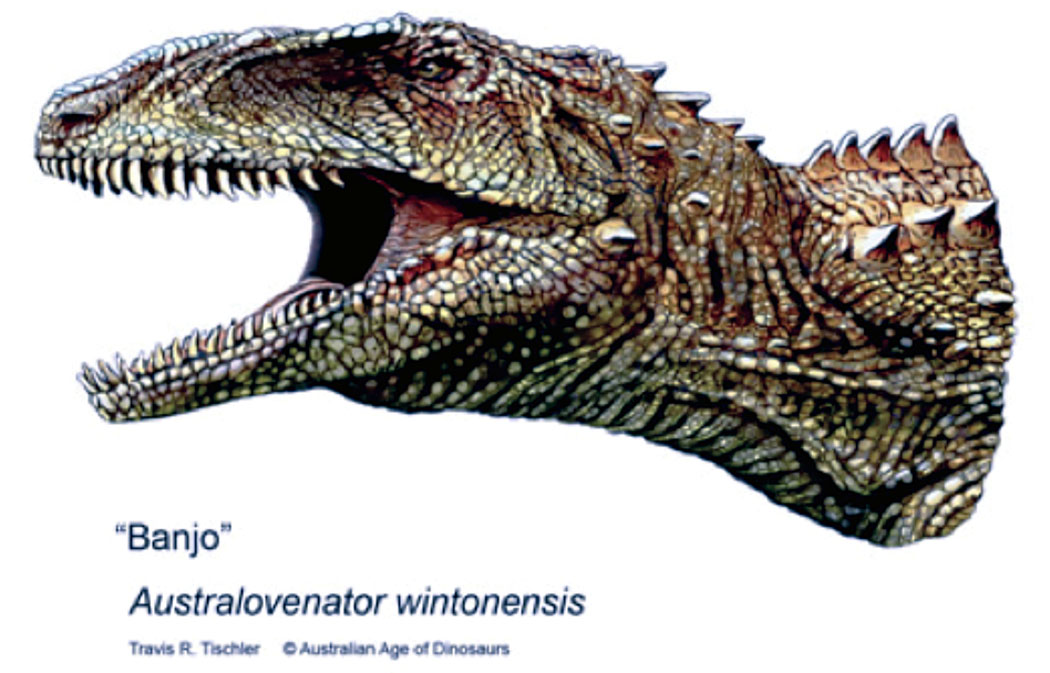
“G’Day! My name is Banjo. I have come here to chew bubblegum, and kick bum. And I'll all out of bubblegum.” Fantastic artwork by Travis Tischler, Australian Age of Dinosaurs.

Monday, December 6, 2010

The Australian Age of Dinosaurs is Now


What is happening right now in Australia with dinosaurs is akin to another time and place on the other side of the world: the 19th century and the American West.